The permitted development rules for garden rooms and outbuildings
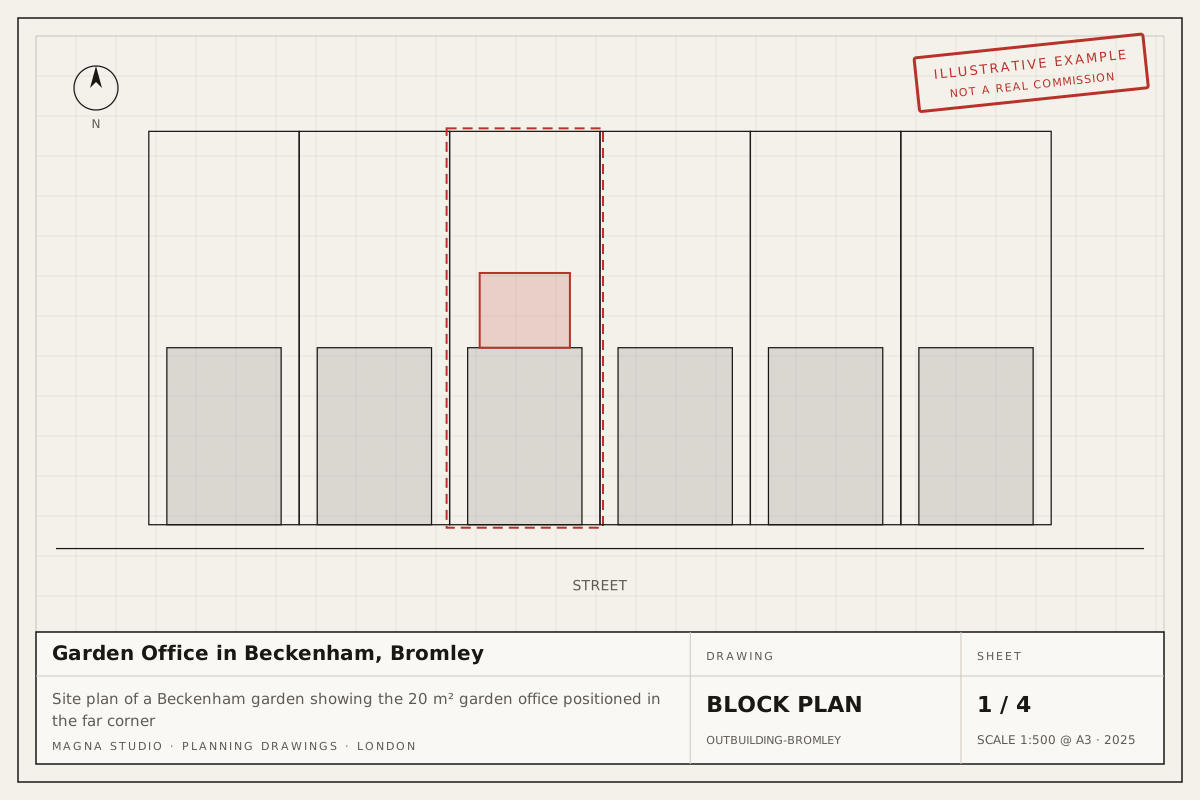
An outbuilding is permitted development on a house if it is single storey, no higher than 2.5 m where it comes within 2 m of a boundary, otherwise no higher than 4 m with a dual-pitched roof or 3 m with any other roof, sits behind the front wall of the house, covers together with other outbuildings no more than half the land around the original house, and is used for purposes incidental to the house rather than as a bedroom or self-contained flat.
Anything used for sleeping or as a separate dwelling needs planning permission regardless of size. Flats have no permitted development rights for outbuildings, and listed buildings need listed building consent.
What changes in Bromley
In a conservation area an outbuilding is still permitted development behind the house, but not to the side of it, and the same height limits apply.
The local constraints that most often decide the route in Bromley are listed below, taken from our Bromley area page. Each one is a reason to confirm the address on Bromley's constraints map before relying on permitted development.
- Conservation areas. Bromley has numerous conservation areas, including Chislehurst, Petts Wood, Bickley Park, Beckenham Place, Sundridge Park, Keston and several around Bromley town centre. Roof extensions are not permitted development inside them and extensions are expected to be clearly subordinate. Check the council's constraints map for your address. Source
- Green Belt and Metropolitan Open Land. Roughly half of the borough is Green Belt or Metropolitan Open Land, taking in Keston, Downe, Cudham, Biggin Hill, Chelsfield and Pratts Bottom. Extensions must not be disproportionate to the original house, and outbuildings are judged strictly. We check the designation before drawing. Source
- Article 4 directions. Several Bromley conservation areas, including parts of Chislehurst and Petts Wood, have Article 4 directions removing permitted development for front-facing alterations, boundary treatments or roof works. The exact restrictions vary by street, so confirm on the council's constraints map before building under PD. Source
- Flood risk – Ravensbourne, Cray and Beck. The River Ravensbourne, Cray, Beck and Pool River corridors through Beckenham, Shortlands, Bromley and St Mary Cray carry fluvial flood risk. Ground-floor extensions in Flood Zones 2 and 3 may need a flood risk statement. Source
What Bromley planning officers look for
Bromley officers are protective of suburban spaciousness. Refusals most often cite two-storey side extensions that close the gap between houses or lack a set-back, rear extensions that breach the 45-degree line to a neighbour, and roof extensions in conservation areas or Areas of Special Residential Character. Rear dormers on ordinary semis outside protected areas are usually accepted if they sit below the ridge and inside the roof slope. The council generally offers a paid pre-application service; decisions often run beyond 8 weeks, so allow 10–14 weeks.
Fees and timelines
The council fee for a householder application is £528 and for a Lawful Development Certificate £264 (England, from 1 April 2025; verify before applying). Both are decided within 8 weeks of validation.
Our own fee for the drawings and the application is fixed once quoted and depends on the project type, its size and the constraints above. Answer six questions in the quote tool and we email you an indicative figure within minutes, then a written fixed-fee quote within 24 hours.