Skip to content
Magna Studio
Menu

Service · London and the Home Counties

Planning appeals and retrospective applications in London

If a London council has refused your application, served an enforcement notice, or you have built something without permission, we review the position honestly and take the route most likely to succeed: a householder appeal, a revised resubmission, or a retrospective planning application under Section 73A. Fixed fees, plain advice on your chances, and drawings that answer the officer's reasons directly.

Indicative fee in two minutes. Written fixed-fee quote within 24 hours.

Fee model
Fixed-fee bands
Typical timeline
3–5 working days + Within 24 hours of review
Coverage
London and the Home Counties
Quote
Within 24 hours
01Who this is for

Is this the right service for your project?

  • Homeowners whose extension or loft application has just been refused
  • Owners who have received an enforcement notice or a planning contravention notice
  • People who built or altered without permission and want to regularise it before selling
  • Buyers who discovered unauthorised works during conveyancing
  • Builders whose clients need a refusal or breach resolved so the job can continue
02Scope

What's included, and what isn't

Every quote lists exactly these items. No surprises after you've signed.

What's included

  • Review of the decision notice, officer report and consultation responses
  • Written advice on prospects, whether to appeal, resubmit with changes or apply retrospectively
  • Appeal statement addressing each reason for refusal against national and local policy
  • Revised or as-built drawings to the standard the Planning Inspectorate expects
  • Lodging the appeal via the Planning Inspectorate portal and managing deadlines
  • Retrospective (Section 73A) application drawings, statement and submission
  • Response to enforcement notices, including appeal grounds where justified
  • Liaison with the council's enforcement and planning officers throughout

Not included (we coordinate these)

  • Council application fees for retrospective applications (verify before applying)
  • Planning barristers or consultants for hearings and inquiries
  • Specialist reports such as daylight and sunlight or heritage assessments
  • Physical alterations needed to make an unauthorised build acceptable
  • Lawful Development Certificates for immune development, quoted separately
03Process

How it works and how long it takes

  1. Step 013–5 working days

    Refusal or notice review

    Send us the decision notice, drawings and any enforcement correspondence. We read the officer's reasoning and the policies cited and tell you which route we recommend.

  2. Step 02Within 24 hours of review

    Strategy and fixed-fee quote

    You receive written advice on prospects, the deadline that applies, and a fixed fee for the appeal or retrospective application.

  3. Step 032–3 weeks

    Drawings and statement

    We prepare revised or as-built drawings and a statement that answers each refusal reason with policy references, precedents and, where useful, amendments.

  4. Step 04Within 2 working days of sign-off

    Lodging

    We lodge the appeal with the Planning Inspectorate or submit the retrospective application to the council and deal with validation.

  5. Step 058 weeks to 6 months

    Determination

    Householder appeals by written representations typically take 4–6 months. A retrospective application is determined within 8 weeks of validation.

04Fees

How our fixed fee for planning appeals & retrospective applications works

One fee, agreed in writing before you commit. Answer six questions and we email you an indicative estimate for your project.

Priced as a fixed fee

  • Refusal review and written prospects adviceDeducted from the fee if you proceed with us
  • Appeal statement and revised drawings (householder appeal)Written representations route
  • Retrospective (Section 73A) application, as-built drawings and submissionEquivalent to the planning fee for the same work, plus an as-built survey
Project type and size
A rear dormer costs less to document than a mansard; a two-storey extension more than a single storey.
Property and constraints
Flats, detached houses, conservation areas and listed buildings need more drawings and a fuller planning case.
How far we take it
Planning drawings only, planning plus Building Regulations, or the full package to tender-ready details.
Indicative pricing

Magna Studio professional fee only, excluding VAT, council fees and any specialist consultants. There is no fee to lodge a planning appeal. Figures are indicative until confirmed in writing.

Council fees, building control fees, structural engineer, party wall surveyor and specialist reports are always separate. We list them in every quote.

Get your instant estimate

A refusal is not the end of a project, and an enforcement letter is not a demand to demolish. Both can be challenged or regularised, but the routes have strict deadlines. We read what the council actually said, tell you plainly what your chances are, and prepare the drawings and statement that give an Inspector or case officer the clearest reason to say yes.

What are my options after a planning refusal in London?

There are two realistic responses to a refusal, and they can run in parallel:

  1. Resubmit with changes. If the reasons point to fixable design issues such as depth, height or window positions, a revised application within 12 months of the decision is usually free of a council fee and takes 8 weeks.
  2. Appeal to the Planning Inspectorate. If the council has misjudged the scheme against its own policies, or refused something it approved next door, an independent Inspector decides the case afresh. There is no fee to appeal.

Our review checks the policies cited against your drawings and comparable approvals nearby. Councils such as Camden and Islington publish detailed design guidance that Inspectors weigh heavily; in outer boroughs such as Bromley or Croydon the argument more often turns on character and neighbour amenity.

How does a householder appeal work?

Most refused extension and loft applications qualify for the Householder Appeals Service: you must lodge within 12 weeks of the decision date, the appeal is decided on written representations only, and neither side can add material the council did not see. Other applications have 6 months to appeal and can proceed by written representations, a hearing or, rarely, an inquiry. Householder appeals typically take 4–6 months from lodging to decision.

What is a retrospective (Section 73A) application?

If the work is already built, a retrospective application under Section 73A asks the council to grant permission for what exists. It is judged on the same planning merits and attracts the same fee as a normal application. The council may decline to consider one once an enforcement notice has been served, so timing matters.

The immunity rules changed in England on 25 April 2024. Breaches substantially completed before that date keep the old 4-year rule for building work and for changes of use to a single dwelling; everything from that date onwards is subject to a 10-year period. Where a breach is already immune, a Lawful Development Certificate for an existing use is the right tool.

What’s included

The review covers the decision notice, officer report, consultation responses and the policies cited, and ends in a short written note on prospects with our recommended route. If you proceed, we produce the appeal or planning statement and revised or as-built drawings to Planning Inspectorate standards, lodge the case and manage every deadline. For enforcement notices we set out the available grounds of appeal.

What’s not included

Council fees for a retrospective application match the normal application fee (£528 for a householder application in England; verify before applying) and are paid by you. Barristers or consultants for hearings and inquiries, specialist reports such as daylight and sunlight assessments, and physical alterations to the building are quoted separately if needed. See our planning documentation service for full application drawings.

Process and timeline

Route Deadline to lodge Typical decision time
Householder appeal (written representations) 12 weeks from decision date 4–6 months
Other planning appeal 6 months from decision date 6–9 months, longer for hearings
Enforcement notice appeal Before the notice takes effect (usually 28 days) 6–12 months
Retrospective application (Section 73A) No deadline, but before enforcement action 8 weeks from validation
Free resubmission of a refused scheme Within 12 months of decision 8 weeks from validation

Fees

Our refusal review and written prospects advice is a small fixed fee, deducted from the fee if you proceed. An appeal statement with revised drawings, and a retrospective application with as-built survey, drawings and submission, are each quoted as a fixed fee depending on what was refused or built. Fees exclude VAT and council fees and are confirmed in writing within 24 hours.

Send us your decision notice or enforcement letter and within a few working days we will tell you whether to appeal, resubmit or regularise, with a fixed fee for each route. Get your instant estimate.

05Questions

Frequently asked questions

How long do I have to appeal a refused planning application?

For a householder application in England you must lodge the appeal within 12 weeks of the date on the decision notice. Most other applications allow 6 months. An appeal against an enforcement notice must be lodged before the notice takes effect, which is usually 28 days after it is served. We diary the deadline on day one so nothing is lost.

Should I appeal or resubmit a revised application?

It depends on why you were refused. If the reasons are matters of design judgement that you can fix, a free resubmission within 12 months is often quicker than an appeal. If the council has misapplied policy or refused something similar to approvals nearby, an appeal is worth pursuing. Our written review sets out both options with our recommendation.

What is a retrospective planning application?

It is an application under Section 73A of the Town and Country Planning Act 1990 for work that has already been carried out. The council assesses it on exactly the same planning merits as a normal application, and the fee is the same. Building without permission is not an offence in itself, but ignoring an enforcement notice is.

Is my unauthorised extension now immune from enforcement?

For breaches that were substantially completed before 25 April 2024, operational development and changes of use to a single dwelling became immune after 4 years and other changes of use after 10 years. For breaches from 25 April 2024 onwards, a single 10-year period applies to everything in England. Immunity is confirmed by a Lawful Development Certificate for an existing use, which we can prepare.

Can I keep building while the appeal is decided?

Building without permission is at your own risk, and continuing work after a refusal can prompt enforcement action and weaken your position with the Inspector. We usually advise pausing work on the disputed element while the appeal or retrospective application runs.

06Examples

Example projects

Typical projects showing the constraints we work through and the planning route we would take.

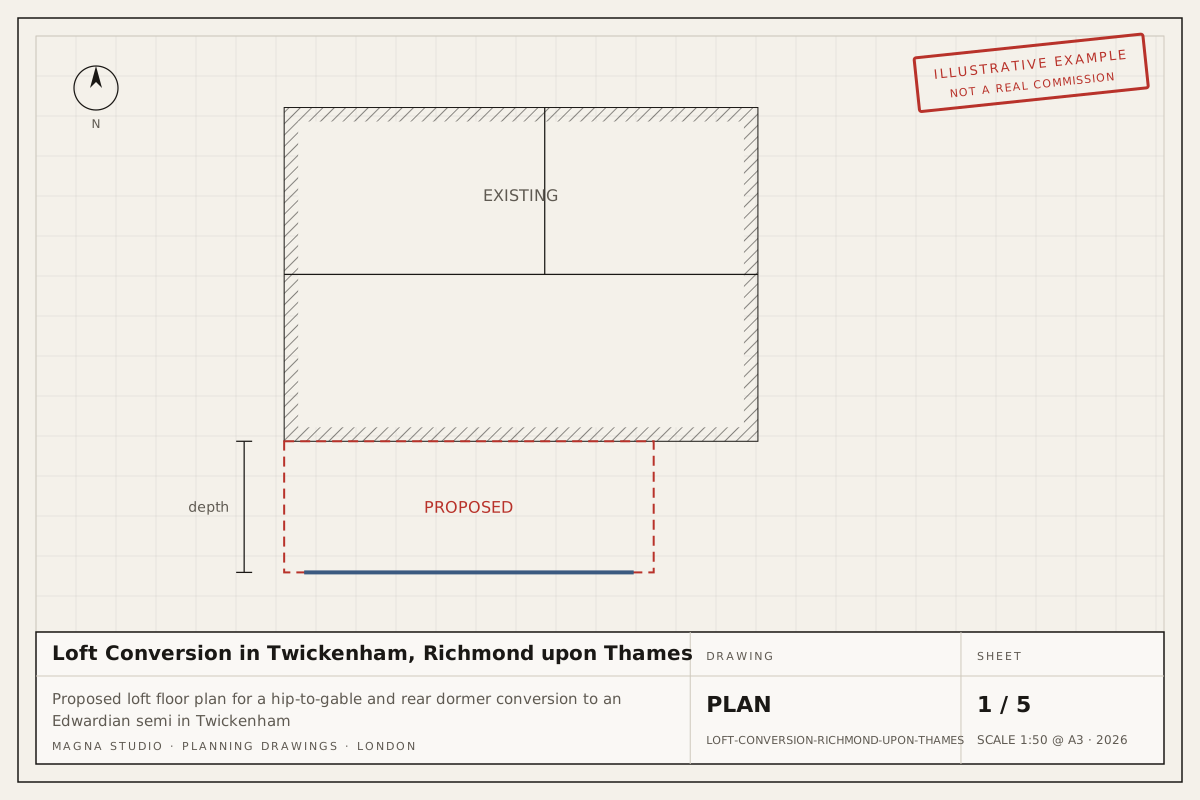
Proposed loft floor plan for a hip-to-gable and rear dormer conversion to an Edwardian semi in TwickenhamExample project
Loft conversionTwickenham, Richmond

Loft Conversion in Twickenham, Richmond upon Thames

Hip-to-gable roof extension with a rear dormer to an Edwardian semi-detached house in a Twickenham conservation area, creating a master bedroom and bathroom in the roof.

Typical route: Householder planning application in an Article 4 conservation area

Next step

Ready to move forward? Get your quote now.

Answer six questions and your indicative fee arrives on screen and by email. Written fixed-fee quote within 24 hours.